

REVOK’s American Dream
What’s in a name?

This essay examines REVOK’s evolution from graffiti writer to studio artist, framing his practice within a broader lineage of artists who use pseudonym and language to assert identity and challenge authority. Set against the cultural and economic backdrop of Dayton and Detroit, it positions his work — and exhibition at The Contemporary Dayton — as a lens for exploring authorship, political expression, and self-mythology.
Jason Williams, better known by his graffiti name, REVOK, admitted to throwing back a few tequila shots before his artist talk at The Contemporary Dayton, where seven new large-scale paintings by the Detroit-based artist are on view through June 6.
“I think graffiti art is the most important American art that has ever existed,” he told curator Heather Jones, who was mediating the conversation.
“Nothing has been practiced by more young, hungry, ambitious artists.”
Born in 1977 in Southern California, REVOK came up in the 1990s graffiti scene, paving the way for his later studio practice. Self-educated — dropping out of school at 15 — he was inspired by comic books, skateboarding culture, and his father’s record collection.
He changed his name — drawn to the visual combination of letters — and started tagging walls. The more subversive the environment, the better. He would sneak out to steal spray paint from neighborhood garages, a practice he says he doesn’t seek to romanticize. It was out of necessity, a way to prove how committed he was and how many materials he could obtain without means.
During those early years he witnessed the arrest of fellow graffiti artists, one serving over a decade, and another shot and killed for trespassing.
“(Graffiti) artists accept willingly what the cost is for making those paintings,” he went on.
“These people have died making paintings a certain way. You have to accept major challenges. I dare you to name any other art movement with that kind of risk.”
There are other art movements with that kind of risk.
Artists have taken on the role of social activist and used their tools as a form of resistance since time immemorial, often resulting in discrimination and persecution.
Just a few examples. David Wojnarowicz and Robert Mapplethorpe each notoriously faced censorship during the AIDS crisis. Two decades later, the Catholic League pressured the Smithsonian’s National Portrait Gallery to remove Wojnarowicz’s work. In 2012, members of feminist collaborative Pussy Riot were sentenced to two years in a Russian penal colony for music and performance art that critiqued Putin. Recently, Iranian filmmaker Jafar Panahi, nominated for an Oscar, returned to his home country to contest a prison sentence for “propaganda activities” against the Iranian regime. His crime? Filming in his country.
Several of REVOK’s art heroes either fled Europe during World War II, or created new movements in America in the wake of the war. Self-taught in art history, he identifies his heroes in the male artists of the DADA, AbEx, Pop Art, and Minimalist movements, artists who he believes distilled ideas into simple language, akin to a graffiti tag.
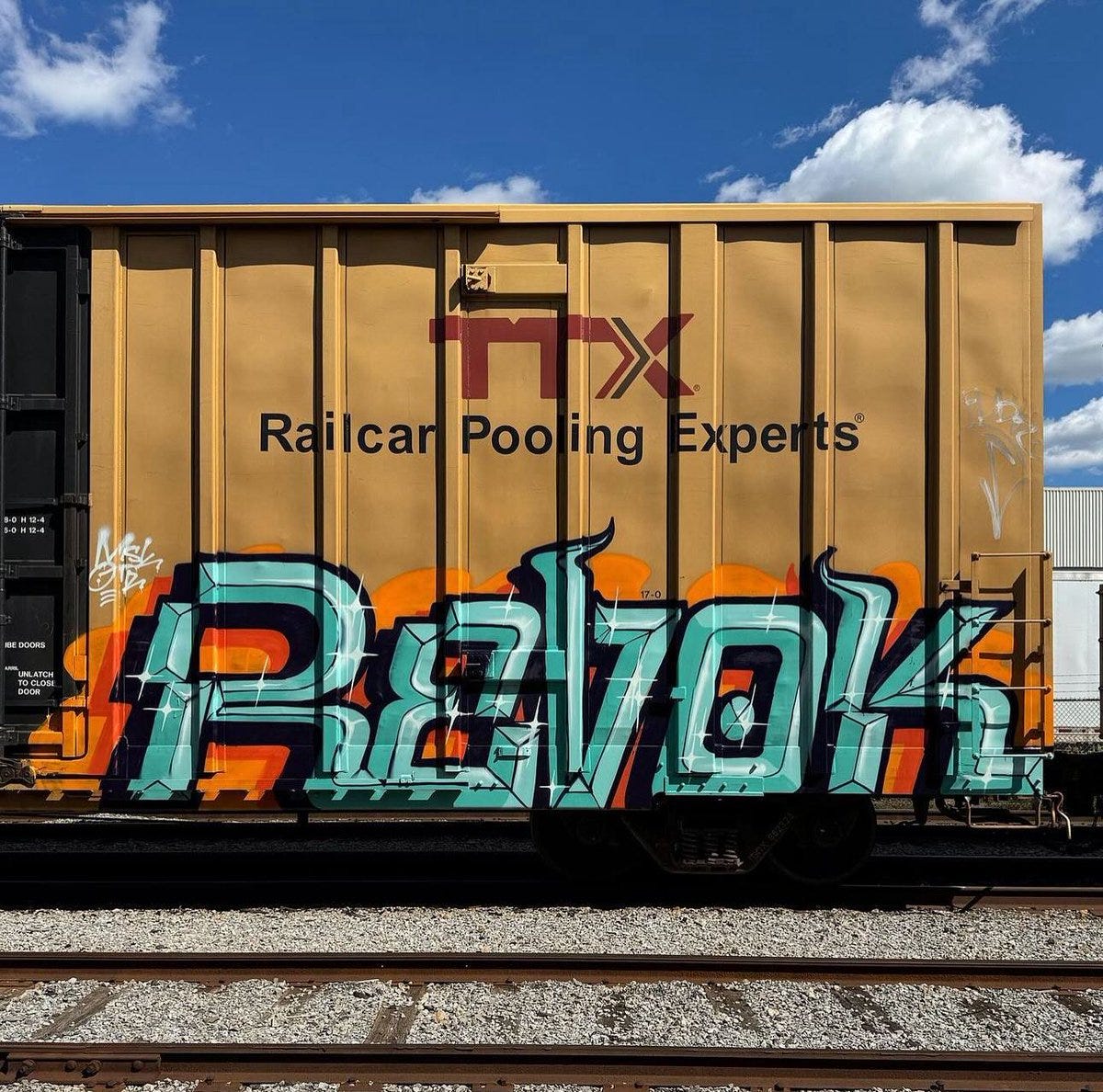
REVOK has developed a mark-making process which involves huge hand-built spray painting machines with cogs, wheels, and the ability to hold eight spray paint cans at a time. The paintings are aftereffects of the physicality of their production technique.
His “instrument frame drag” contraptions pull paint across surfaces in a fine-tuned yet unpredictable manner. Though the gesture is planned, the paint drips and such are spontaneous — evidence of the action. The process theoretically allows for quick work in restricted areas, though these tools are intended more for gallery walls than brick ones. REVOK is aware of the institutional contrast in these environments.
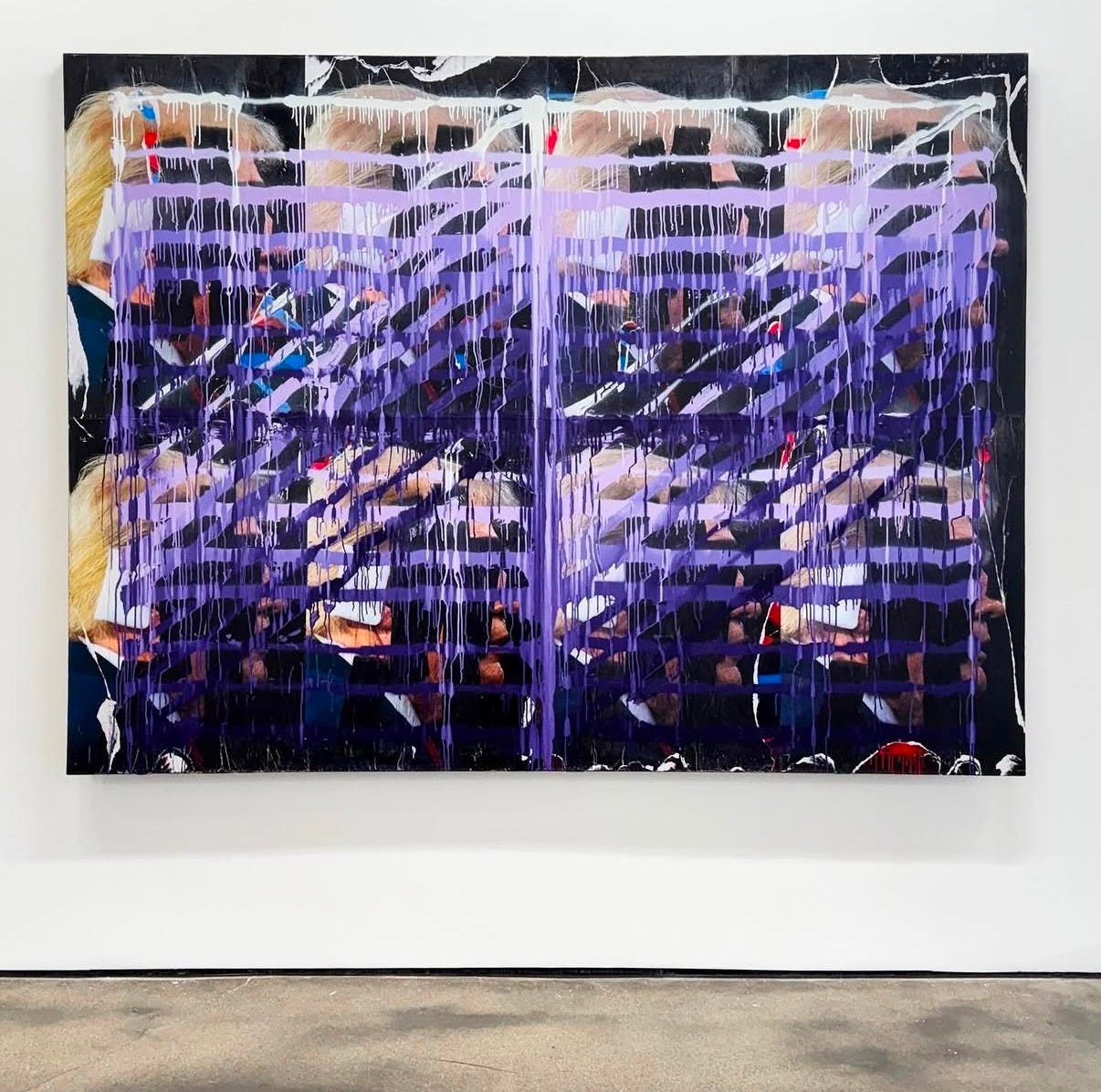
At The Contemporary Dayton, REVOK has created three paintings incorporating the likeness of Donald Trump — his portrait repeated in a grid formation like an Andy Warhol screen print. The images of Trump are digitally manipulated posters — black strips added to the faces before printing — with the redacted Epstein Files cited as inspiration. The finishing painterly effect happens when REVOK drags his frame machine across the mounted posters. The hand of the artist occurs via a calibrated machine. Happening in minutes in his studio, it becomes public performance art once it hits his social media page.
The Contemporary Dayton is marking its 35th anniversary alongside the United State’s 250th birthday by centering the theme of Freedom of Expression, saying it supports artists’ rights to freedom of speech, particularly when engaging complex ideas.
“We as an organization are neutral. We neither support nor condemn any political figure, but we are really invested in allowing the First Amendment,” said Jones.
The phrasing was measured.
For context, The Contemporary Dayton is a nonprofit art center located an hour north of Cincinnati and a bit further southwest from Columbus. Before the term “flyover state” became annoyingly prevalent, the mid-sized Midwestern city was a prosperous center of innovation. Famous for the birthplace of the Wright Brothers and aviation, and home to a shocking number of other inventions — the electric car starter, the pop-top can, the stepladder, portable cribs, the cash register, gas masks, Cheez-it crackers, looseleaf binders, the barcode, the movie projector, and on and on — Dayton’s industrious pride is woven into the fabric of the place.
Dayton was historically a major industrial and manufacturing hub, hosting companies like National Cash Register, Mead Paper, Reynolds and Reynolds, and Delco, along with a massive General Motors presence. Like so many Rust Belt cities, globalization of industry and generational exodus to larger urban centers left Dayton economically devastated. Blocks of houses stretch out like wasteland, and the city remains geographically segregated from historic redlining and highway bifurcation. Check out the 2019 documentary “American Factory” by local filmmakers Steven Bognar and Julia Reichert, for a look at what happened when Fuyao Glass Industry Group took over the former GM plant.
Like Detroit, which Jones refers to as Dayton’s big sister, what was creatively left in the wake of this loss of industry was a scrappy yet persistent DIY community of artists and musicians. Out of Dayton tumbled indie greats The Breeders, Brainiac, and Guided by Voices. Fed by the Great Migration and a thriving nightclub scene, Dayton became known as the “Land of Funk”, birthing the Ohio Players, Slave, Zapp, Heatwave, Lakeside, Sun, and Faze-O.
Artists and musicians, drawn to the cheap studio spaces, relatively low cost of living, and DIY spirit, are still a fixture, and it was out of this resiliency that the Dayton Visual Arts Center was born. Founded in the 1990s as a members-run space for local artists, it moved from place to place for 30 years before rebranding as The Contemporary Dayton and moving into a new 6,000 square foot industrial-minimalist gallery. Not all of the established members were pleased with these changes, but as a New Yorker who relocated to Dayton in 2020, I was excited about what was going on under the leadership of Executive Director Eva Buttacavoli and former curator Michael Goodson.
In terms of polarizing subject matter at The Contemporary Dayton, race has been addressed in several past exhibitions. (I can’t believe I have to call race “polarizing” in 2026, but here we are.) Religion has been referenced. But work critiquing a right wing politician seems like more delicate territory in this region. Blame it on the conservative-leaning Midwestern audience-at-large, or the precarious state of arts funding. Perhaps it’s with some trepidation that arts organizers here stir the pot, but REVOK isn’t worried.
“You can have a group of people in a room presented with the same information, interpreting it totally differently,” said REVOK of his politically-charged work.
Hence the name of the exhibit — “Mutually Exclusive”.
Abandoned by his mother and growing up with little means, graffiti culture, for REVOK, provided a way to build self worth.
“I was never seen, heard or valued,” he said of his childhood.
“I always felt alone. I wanted to take ownership over my identity.”
He built a following based on writing his new name over and over because he wanted to “be a big deal”. Then, desiring a legacy in which the images would live on, he developed a successful studio practice.
Graffiti writers owe a nod to the avant-garde artists who created pseudonyms in order to express ideas that challenged authority. In his dialogue with Jones, REVOK mentioned the first time he saw Marcel Duchamp’s “Fountain”, the porcelain urinal reborn as a readymade. The audacity blew him away.
What’s in a name? For Duchamp, that is an abundant question. He experimented with several identities. His primary alter ego, Rrose Sélavy, was a female persona created around 1920. The name is a pun on the French phrase “Eros, c’est la vie” (“Eros, that’s life” or “Sex, that’s life” among the many interpretations). Rrose Sélavy, appearing in a hat and eyeliner, was often photographed by Man Ray, and allowed Duchamp to explore gender fluidity, Dadaist irony, and authorship.
While Rrose is most famous, Duchamp bestowed other identities, including “Marchand du Sel” (Salt Seller), a pun on his own name, and R. Mutt, the famous pseudonym and alter ego used by Duchamp to sign his 1917 readymade commode.
Submitted to the Society of Independent Artists, R. Mutt allowed Duchamp to present work without using his established reputation, testing the art world’s dedication to the claim of “independent artist”. They ultimately rejected the piece.
While Duchamp took on aliases to stand out, several artists of the era — his friends and collaborators — did so foremost to avoid discrimination. Born Emmanuel Radnitzky to Russian Jewish immigrants, Man Ray separated his birth name from his artistic persona. Dadaist Tristan Tzara was born Samuel Rosenstock. Marc Chagall adapted his name from the original Moishe Shagal.
Duchamp loved messing around with names and language.
In “L.H.O.O.Q.” (1919) the found object is a postcard reproduction of the “Mona Lisa” onto which Duchamp drew a mustache and beard and changed the title to what looks like an acronym but is actually a gramogram. Satire of “Mona Lisa” in the history of art and advertising is a topic for another day, but this is to say that the name of the piece, “L.H.O.O.Q.”, is another of Duchamp’s linguistic teases. The letters pronounced in French sound like “Elle a chaud au cul”, or, “She has a hot ass”. Less literally but perhaps more on the mark — “She is horny”.
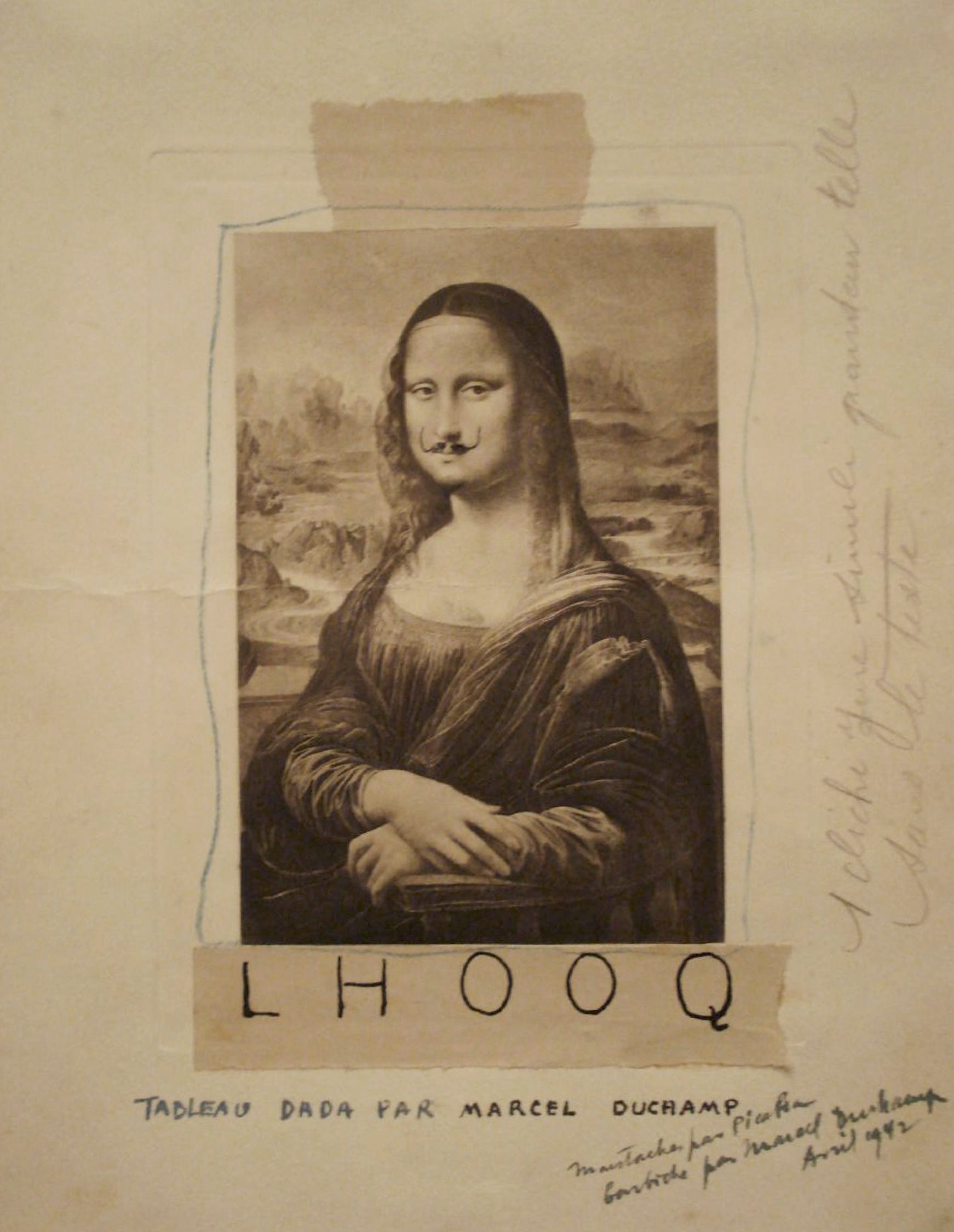
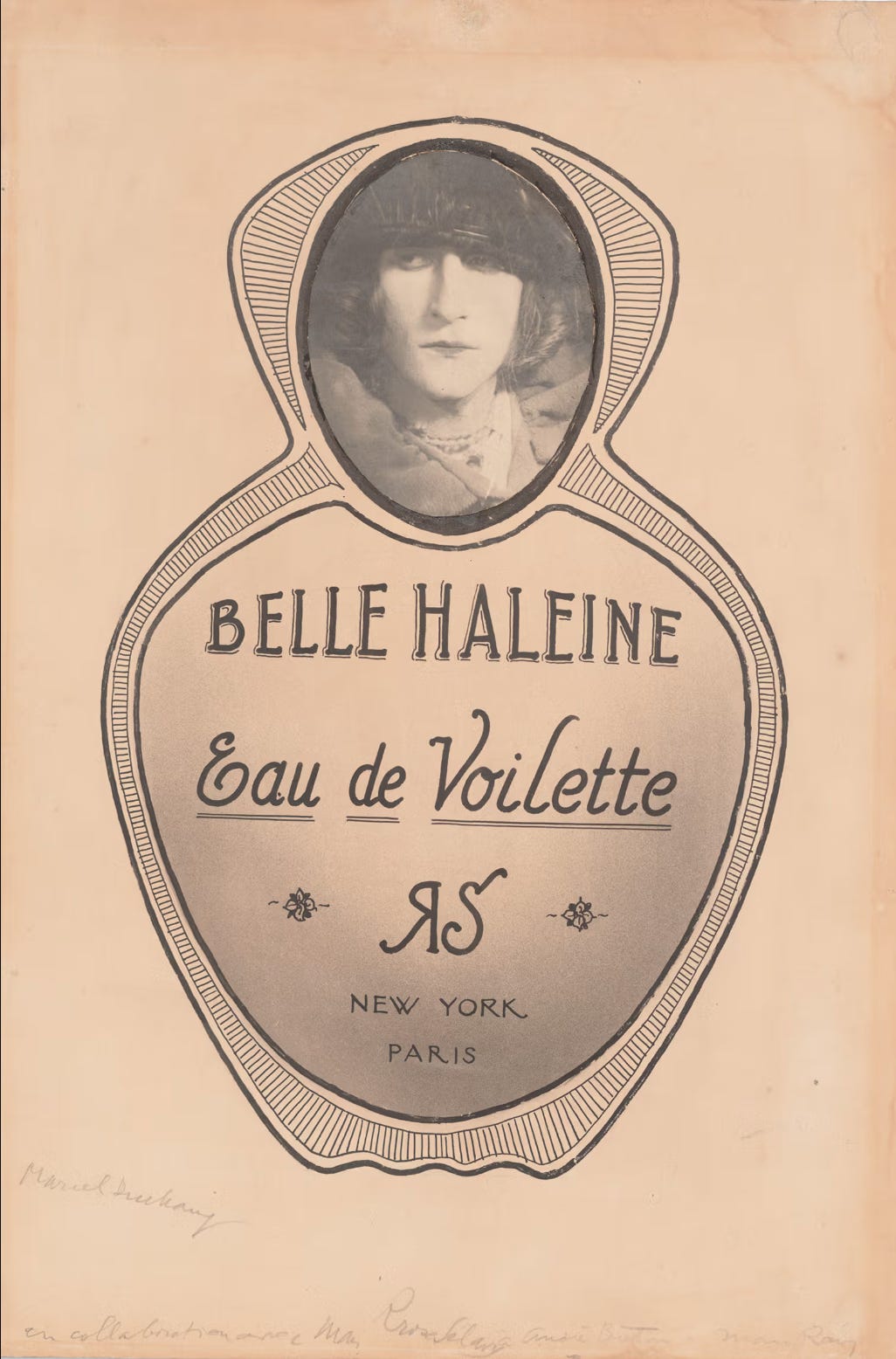
It wasn’t just Duchamp who had a pseudonym, it was the actual character in the artwork that dwelled in multiple identities, and in doing so, danced with nonconformity and questioned the authority of the art establishment. The readymade represented art moving on from the visual to the conceptual, both complicating and simplifying what we see.
So here is REVOK, using his “instrument frame drag” to deface a portrait of Donald Trump in order to endow it with new context. The black marks that allude to the lines in redacted files hint at the pliability of language, to what is shown and what remains unseen. Titled “Anti-fascist/PIG_framedrag/inst_ex_3_Vio”, the piece is an act of defiance.
The pseudonym is not just disguise, but the actual site of artistic production and identity. The alias becomes the author who writes his own story. Like Joseph Campbell described in “The Hero with a Thousand Faces”, creating one’s own mythology is a tool for meaning-making. It serves as a path to reclaiming agency over one’s identity. As the traditional belief systems of childhood lose power and influence, creating a personal myth empowers individuals to define their own reality.
“I wanted to take ownership over my identity,” said REVOK of why he tagged.
“I didn’t want to be a nobody. Art making seemed like a conduit to transcend caste. I didn’t accept being powerless.
“That’s kind of the American dream.”
“Mutually Exclusive” is on view 11 a.m.-6 p.m. Wednesday-Saturday at The Contemporary Dayton, 25 W. 4th St., Dayton through June 6. Running concurrently are the works of Detroit artists Paul Verdell and Jamea Richmond-Edwards.